
🔍 Step-by-Step Troubleshooting Guide
1️⃣ Check the Thermostat Settings
Before diving into repairs, ensure:
✅ The thermostat is set to COOL mode.
✅ The temperature is set lower than room temperature.
✅ The fan setting is on AUTO (not just ON).
✅ Try resetting the thermostat by turning it OFF for 1-2 minutes, then ON again.
🚀 If the thermostat is fine, move to the next step.
2️⃣ Check the Circuit Breaker & Power Supply
Your outdoor AC unit has two power sources:
1️⃣ Main electrical panel (circuit breaker) – Check if the breaker for the AC has tripped.
- If tripped: Turn it OFF, then back ON.
- If it trips again immediately: There may be a short circuit—call an HVAC technician.
2️⃣ Outdoor disconnect switch – Open the small box near the outdoor unit and ensure the switch is ON.
🚀 If power is fine, move to the next step.
3️⃣ Manually Spin the Fan (Quick Test for a Bad Capacitor)
- Take a stick or screwdriver (not your fingers!) and push the fan blades.
- If the fan starts spinning but stops after a few seconds → The capacitor is likely bad.
- If the fan won’t spin at all or feels stuck → The fan motor may be bad.
🚀 If the fan tries to start, move to step 4 (check the capacitor).
4️⃣ Check & Replace the Capacitor (Most Common Issue!)
The capacitor is a small, cylindrical part that helps start the fan and compressor. If it fails, the fan won’t run.
Signs of a Bad Capacitor
✔ Fan tries to start but fails (hums, then stops).
✔ The capacitor is bulging or leaking oil.
✔ AC works fine inside but the outdoor fan isn’t spinning.
How to Replace the Capacitor
⚠ Warning: Capacitors store high voltage—turn off power before handling!
1️⃣ Turn off power at the breaker box and disconnect switch.
2️⃣ Remove the outdoor unit panel (use a screwdriver).
3️⃣ Locate the capacitor (a metal cylinder with wires).
4️⃣ Look for bulging, leaks, or burn marks.
5️⃣ Use a multimeter to test capacitance (if you have one).
6️⃣ Replace with a capacitor of the same µF rating (found on the label).
🚀 If replacing the capacitor doesn’t fix it, move to step 5 (check the contactor).
5️⃣ Check & Replace the Contactor (Power Relay Switch)
The contactor is a switch that sends power to the compressor and fan. If it’s faulty, the fan won’t run.
Signs of a Bad Contactor
✔ Clicking noise, but nothing happens.
✔ The fan starts only if you manually press the contactor.
✔ The contactor is burnt or pitted (visible damage).
How to Replace the Contactor
1️⃣ Turn off power at the breaker and disconnect switch.
2️⃣ Locate the contactor (a small black/brown box with wiring).
3️⃣ Check for burnt or corroded contacts.
4️⃣ If faulty, replace it with an identical model.
🚀 If the contactor is fine but the fan still won’t run, move to step 6 (check the fan motor).
6️⃣ Check the Fan Motor (If Everything Else is Fine)
If the capacitor and contactor are fine, the fan motor may have failed.
Signs of a Bad Fan Motor
✔ Fan won’t spin even with a push.
✔ Buzzing sound but no movement.
✔ The motor feels very hot.
✔ The fan moves very stiffly or is stuck.
How to Fix
- If the motor is stuck or stiff, it may need lubrication.
- If the motor doesn’t respond at all, it likely needs replacement.
- Check if the motor is getting power using a multimeter.
🚀 If the motor is bad, it needs to be replaced (step 7).
7️⃣ Check for a Refrigerant Leak (Low-Pressure Switch)
- Some AC units shut down the fan if refrigerant levels are too low.
- Look for ice buildup on the refrigerant lines or hissing sounds (leak).
- Solution: Call a licensed HVAC technician to check refrigerant levels and repair leaks.
🔎 Summary: Why Your Outdoor AC Fan Won’t Run
| Possible Issue | Signs | Fix |
|---|---|---|
| Bad capacitor | Fan hums but doesn’t spin, works if pushed | Replace capacitor |
| Bad contactor | Clicking noise, no power to fan | Replace contactor |
| Tripped breaker | No power to unit | Reset breaker |
| Blown fuse in disconnect box | No power | Replace fuse |
| Fan motor failure | Fan won’t spin, overheating | Replace fan motor |
| Low refrigerant | Ice on lines, hissing sound | Call technician |
💡 Final Advice
🔹 Start with easy fixes (power check, manually spin the fan).
🔹 If the fan moves but doesn’t start, replace the capacitor (common issue).
🔹 If power is fine but nothing works, check the contactor and motor.
🔹 If the compressor is running but the fan isn’t, replace the fan motor.
🔹 If refrigerant is low, call a technician.
Would you like step-by-step guidance on replacing a capacitor or fan motor? 😊
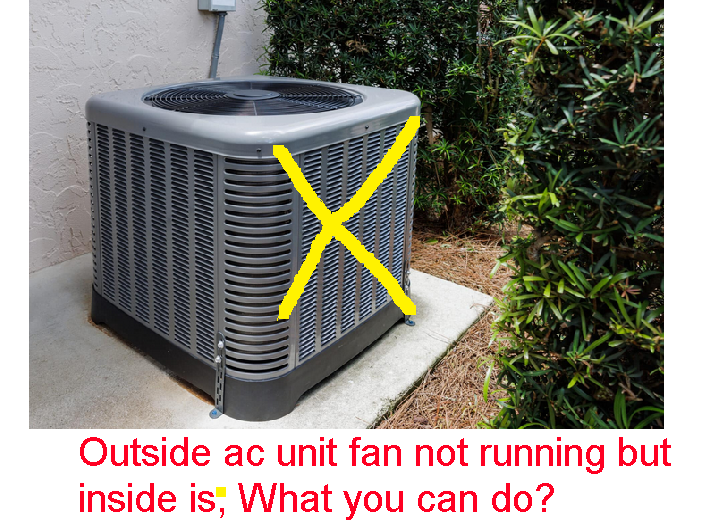
If your inside unit (air handler) is running, but the outdoor AC unit’s fan is not spinning, it usually indicates a power issue, bad capacitor, faulty contactor, or a failed fan motor. Follow these step-by-step troubleshooting steps to fix it.
🔍 Step-by-Step Troubleshooting Guide
1️⃣ Check the Thermostat Settings
Before diving into repairs, ensure:
✅ The thermostat is set to COOL mode.
✅ The temperature is set lower than room temperature.
✅ The fan setting is on AUTO (not just ON).
✅ Try resetting the thermostat by turning it OFF for 1-2 minutes, then ON again.
🚀 If the thermostat is fine, move to the next step.
2️⃣ Check the Circuit Breaker & Power Supply
Your outdoor AC unit has two power sources:
1️⃣ Main electrical panel (circuit breaker) – Check if the breaker for the AC has tripped.
- If tripped: Turn it OFF, then back ON.
- If it trips again immediately: There may be a short circuit—call an HVAC technician.
2️⃣ Outdoor disconnect switch – Open the small box near the outdoor unit and ensure the switch is ON.
🚀 If power is fine, move to the next step.
3️⃣ Manually Spin the Fan (Quick Test for a Bad Capacitor)
- Take a stick or screwdriver (not your fingers!) and push the fan blades.
- If the fan starts spinning but stops after a few seconds → The capacitor is likely bad.
- If the fan won’t spin at all or feels stuck → The fan motor may be bad.
🚀 If the fan tries to start, move to step 4 (check the capacitor).
4️⃣ Check & Replace the Capacitor (Most Common Issue!)
The capacitor is a small, cylindrical part that helps start the fan and compressor. If it fails, the fan won’t run.
Signs of a Bad Capacitor
✔ Fan tries to start but fails (hums, then stops).
✔ The capacitor is bulging or leaking oil.
✔ AC works fine inside but the outdoor fan isn’t spinning.
How to Replace the Capacitor
⚠ Warning: Capacitors store high voltage—turn off power before handling!
1️⃣ Turn off power at the breaker box and disconnect switch.
2️⃣ Remove the outdoor unit panel (use a screwdriver).
3️⃣ Locate the capacitor (a metal cylinder with wires).
4️⃣ Look for bulging, leaks, or burn marks.
5️⃣ Use a multimeter to test capacitance (if you have one).
6️⃣ Replace with a capacitor of the same µF rating (found on the label).
🚀 If replacing the capacitor doesn’t fix it, move to step 5 (check the contactor).
5️⃣ Check & Replace the Contactor (Power Relay Switch)
The contactor is a switch that sends power to the compressor and fan. If it’s faulty, the fan won’t run.
Signs of a Bad Contactor
✔ Clicking noise, but nothing happens.
✔ The fan starts only if you manually press the contactor.
✔ The contactor is burnt or pitted (visible damage).
How to Replace the Contactor
1️⃣ Turn off power at the breaker and disconnect switch.
2️⃣ Locate the contactor (a small black/brown box with wiring).
3️⃣ Check for burnt or corroded contacts.
4️⃣ If faulty, replace it with an identical model.
🚀 If the contactor is fine but the fan still won’t run, move to step 6 (check the fan motor).
6️⃣ Check the Fan Motor (If Everything Else is Fine)
If the capacitor and contactor are fine, the fan motor may have failed.
Signs of a Bad Fan Motor
✔ Fan won’t spin even with a push.
✔ Buzzing sound but no movement.
✔ The motor feels very hot.
✔ The fan moves very stiffly or is stuck.
How to Fix
- If the motor is stuck or stiff, it may need lubrication.
- If the motor doesn’t respond at all, it likely needs replacement.
- Check if the motor is getting power using a multimeter.
🚀 If the motor is bad, it needs to be replaced (step 7).
7️⃣ Check for a Refrigerant Leak (Low-Pressure Switch)
- Some AC units shut down the fan if refrigerant levels are too low.
- Look for ice buildup on the refrigerant lines or hissing sounds (leak).
- Solution: Call a licensed HVAC technician to check refrigerant levels and repair leaks.
🔎 Summary: Why Your Outdoor AC Fan Won’t Run
| Possible Issue | Signs | Fix |
|---|---|---|
| Bad capacitor | Fan hums but doesn’t spin, works if pushed | Replace capacitor |
| Bad contactor | Clicking noise, no power to fan | Replace contactor |
| Tripped breaker | No power to unit | Reset breaker |
| Blown fuse in disconnect box | No power | Replace fuse |
| Fan motor failure | Fan won’t spin, overheating | Replace fan motor |
| Low refrigerant | Ice on lines, hissing sound | Call technician |
💡 Final Advice
🔹 Start with easy fixes (power check, manually spin the fan).
🔹 If the fan moves but doesn’t start, replace the capacitor (common issue).
🔹 If power is fine but nothing works, check the contactor and motor.
🔹 If the compressor is running but the fan isn’t, replace the fan motor.
🔹 If refrigerant is low, call a technician.
